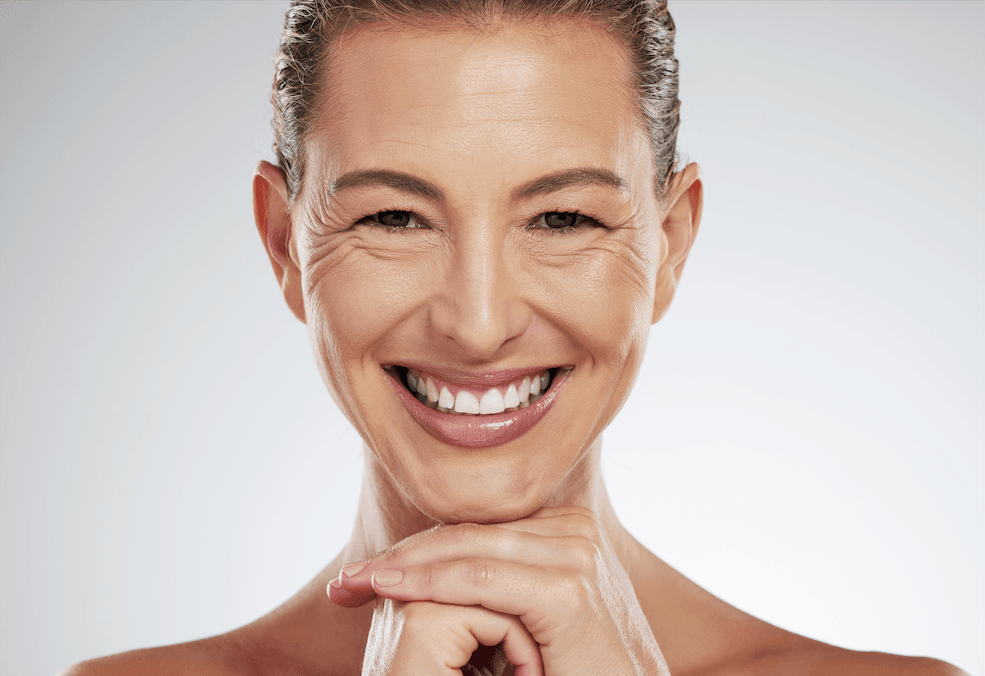
Crepey skin is a common yet often misunderstood manifestation of skin aging. It is defined by thin, fragile, finely wrinkled skin with reduced elasticity, resulting in a delicate, paper‑like appearance. Unlike deeper wrinkles or laxity driven primarily by volume loss, crepey skin reflects deterioration in skin quality and dermal structure itself.
This change most often appears in areas where the skin is naturally thinner and exposed to frequent motion or environmental stress, including the under‑eye area, anterior neck, décolletage, and inner upper arms.
Understanding the biological drivers of crepey skin is essential to selecting treatments that genuinely improve skin quality rather than offering only temporary cosmetic improvement.
The Structural Basis of Crepey Skin
Crepey skin is a common yet often misunderstood manifestation of skin aging. It is defined by thin, fragile, finely wrinkled skin with reduced elasticity, resulting in a delicate, paper‑like appearance. Unlike deeper wrinkles or laxity driven primarily by volume loss, crepey skin reflects deterioration in skin quality and dermal structure itself.
This change most often appears in areas where the skin is naturally thinner and exposed to frequent motion or environmental stress, including the under‑eye area, anterior neck, décolletage, and inner upper arms.
Understanding the biological drivers of crepey skin is essential to selecting treatments that genuinely improve skin quality rather than offering only temporary cosmetic improvement.
Why the Anterior Neck Shows Crepey Skin Early
The anterior neck is one of the most common and earliest areas to develop crepey skin. This is not accidental—it reflects a convergence of anatomy, exposure, and biomechanics.
Key contributors include:
Thin skin with minimal subcutaneous support
Unlike the face, the neck lacks robust fat compartments that provide structural buffering as collagen declines.
Reduced barrier function
The neck contains fewer sebaceous glands, resulting in lower natural oil production and increased transepidermal water loss (TEWL). This contributes to chronic dehydration and barrier vulnerability.
Cumulative ultraviolet exposure
The neck is often exposed to the sun yet frequently excluded from daily sunscreen and skincare routines that stop at the jawline.
Constant mechanical stress
Daily flexion, rotation, and extension—exacerbated by prolonged device use (“tech neck”)—place repetitive strain on already thinning dermal tissue.
Together, these factors explain why neck crepey skin often appears earlier than facial aging, even in individuals who otherwise practice diligent skincare.
Why Moisturizer Alone Does Not Correct Crepey Skin
Moisturizers play an important supportive role by improving barrier function and reducing water loss. They can temporarily soften the appearance of fine textural changes and improve comfort.
However, moisturizers cannot restore lost collagen and elastin.
Crepey skin is driven by structural dermal decline, not simply dehydration. For this reason, topical hydration should be viewed as adjunctive care rather than a corrective solution.
Evidence‑Based Treatments for Crepey Skin
Meaningful, lasting improvement requires interventions that stimulate repair and regeneration within the dermis.
Topical Retinoids
Retinoids can promote epidermal turnover and support collagen synthesis with consistent use. However, the neck and décolletage are more sensitive than facial skin, requiring careful formulation selection, lower concentrations, and gradual introduction to avoid irritation and barrier compromise.
Energy‑Based and Injury‑Stimulating Procedures
Energy‑based devices create controlled dermal injury that activates fibroblasts and stimulates new collagen and elastin production.
At Integrated Aesthetics, non‑surgical options such as ultrasound‑based skin tightening are frequently used to address crepey skin at the structural level.
- Sofwave® ultrasound technology delivers precise energy into the mid‑dermis to trigger collagen remodeling without downtime
These treatments are designed to improve skin thickness, resilience, and quality over time, rather than simply tightening the surface.
Microneedling
Microneedling induces controlled micro‑injury that initiates a wound‑healing cascade, stimulating new collagen formation and improving skin texture.
This approach can be particularly effective when used as part of a collagen‑restoration strategy, especially for early to moderate crepey changes.
Biostimulators (e.g., Radiesse®)
Biostimulatory injectables such as calcium hydroxylapatite (CaHA) play a unique role in treating crepey skin—especially on the neck.
When appropriately diluted and placed, CaHA does not act as a traditional volumizing filler. Instead, it functions as a collagen‑stimulating scaffold, encouraging the skin to rebuild its own structural support.
This makes biostimulators particularly well‑suited for crepey skin, where loss of dermal quality—not volume deficiency—is the primary concern.
A Preventive Framework for Long‑Term Skin Health
While established crepey skin can be improved, prevention remains foundational, especially for vulnerable areas like the neck and décolletage.
- Consistent sun protection is the single most effective way to slow collagen and elastin degradation
- The neck should be treated as an extension of the face in daily skincare and sunscreen routines
- Regular moisturization supports barrier integrity and improves tolerance to both environmental stress and active treatments
Crepey skin develops where anatomy, exposure, motion, and time intersect. Addressing it effectively means selecting interventions that support the skin’s structure—not just its surface appearance.
Schedule a Consultation
Crepey skin reflects structural changes within the dermis and benefits from an individualized, anatomy‑based approach. At Integrated Aesthetics in Spring, Texas, Dr. Melissa Chiang, board‑certified dermatologist, evaluates skin quality at a deeper level—considering tissue health, biomechanics, and collagen integrity—to recommend evidence‑based treatment strategies.
A consultation allows for personalized assessment and discussion of options designed to improve dermal strength, resilience, and long‑term skin quality.
Schedule a consultation today to learn whether treatment may be appropriate for you.